domingo, 3 de enero de 2016

17 indices on nakedness


17 indices on nakedness*
On ‘The Naked Soul’ by Syd Krochmalny


Lucas Soares**


  1. In the time of Cronus and in the reign of Zeus, there was a law according to which men and women who had lived just and pious lives were sent on their deaths to the Isle of the Blessed to live in perfect happiness; in contrast, those who had lived unjust and impious lives were confined to Tartarus, prison of unending expiation, punishment and grief. As so often even with the best laid plans, there were problems: judgment was often defective and the dead were sent to the wrong place. In response to calls by Pluto and by the guardians of the Island of the Blessed, Zeus took a key decision to guarantee the justice of decisions as to the final destination of humans after death: ‘I shall put a stop to this. At the moment the judgments are not well given, because the persons who are judged have their clothes on, for they are alive; and there are many who, having evil souls, are apparelled in fair bodies, or encased in wealth or rank, and when the day of judgement arrives, numerous witnesses come forward and testify on their behalf that they have lived righteously. The judges are awed by them, and they themselves also have their clothes on when judging; their eyes and ears and their whole bodies are interposed as a veil before their own souls.  All this is a hindrance to them. Their clothes, and those of the judged, are the obstacles that hinder justice. What is to be done? In the first place, I will deprive human beings of the foreknowledge of death, which they possess at present. In the second place, they shall entirely stripped before they are judged, for they shall be judged when they are dead; and the judge too shall be naked, that is to say, dead.  For justice to be done, let the judges only employ their souls to examine the souls of others immediately after their death, when separated from all family and after leaving all possessions behind on Earth’. The mythic, poetic and visual potential of this image is strong: naked and dead, Minos, Radamanthys and Aeacus, sons of Zeus and the three judges of the dead in Hades, judged the naked and dead, whose souls were sent according to the just or unjust lives they had led to the Isle of the Blessed or to Tartarus respectively. One of the most interesting aspects of this myth, with which Plato closes the Gorgias, is the idea of clothing as an obstacle to judgement as to a person’s moral condition – whether just or unjust, pious or impious. In the first instance, The Naked Soul may be seen as an attempt to reconstruct this image obsessively. By means of a ‘work against the current times’ (Nietzsche), Syd Krochmalny appropriates, deconstructs and reconstructs this image in order to realise a contemporary reworking of the Platonic myth in the image of the English activist, Stephen Gough: in it, the latter becomes the judge who will judge us and our clothes, in the wake of his solitary crusade across the British mainland. Krochmalny fashions the Gorgias into a logos with which to think through the question of nakedness, and more specifically, the physical, epistemic, political and legal discomfort, that nakedness produces in the onlooker.


  1. Nakedness reveals all the contours inscribed on our bodies over the course of our lives: folds, wrinkles, wounds, scars, cares, illnesses.  All is visible: the crooked and the straight; the noble and the base. What is it that clothing conceals? The imprint of the soul on a naked body and the imprint of a body on a naked soul. Letting the veil of clothing fall reveals all the marks left by our behaviours and actions. In The Naked Soul, clothing becomes a physical and spiritual obstacle to the ends of sociability and free movement, and to the rediscovery of our most primitive self-determination and liberty.


  1. Our appreciation of Stephen Gough’s act reveals the prison of our own habits and customs, while, at the same time, reinforcing the pristine liberty of his own being.  His crusade for nakedness gathers force with each viewing.  From this tension emerges his care of self. In this sense, The Naked Soul extends Stephen Gough’s gesture. For, among other things, the idea is to sow the idea of nakedness in the mind of the spectator.


  1. From Adam and Eve to our times, nakedness supposes being seen by another. Being naked always supposes being naked for someone else. Through the figure of Stephen Gough, the nakedness proposed by The Naked Soul seeks to transcend this other, establishing itself as an autonomous nakedness, self conscious, and free from the ties that would enslave it to the conservative gaze of others, and from a gaze that will only tolerate it when exhibited for a spectator-consumer. Krochmalny’s Gough does not disrobe for a spectator, but for himself.  This is his technology of self. And this is what makes Krochmalny’s appropriation of Gough’s act truly disruptive in aesthetic, political and legal terms.


  1. In Ways of Seeing, Berger identifies a difference between ‘nakedness’ and ‘nudity’: ‘Nakedness reveals to itself. Nudity is placed on display. ....To be naked is to be without disguise.  To be on display is to have the surface of one’s own skin, the hairs of one’s own body, turned into a disguise. The nude is condemned to never being naked. Nudity is a form of dress.’ The Naked Soul does not aim for nudity, but for that nakedness that in the very moment that it reveals itself before others, reveals all of its contours to itself. Nakedness as a way of seeing the world.


  1. There are then two types of nakedness; one that conceals and one that reveals. The first is an atavistic nakedness: nakedness as spectacle, devoted to exhibitionist values, and dedicated exclusively to a consumer-spectator. When we consider nakedness in the media, in pornography, on the beach and even in art (the large-scale nude shots of Spencer Tunick for example), the aftertaste of clothing is present in all of them. Here there is no tension. Here there is no trace, properly speaking, of nakedness, but only its atavistic and impersonal appearance. It is precisely this anonymous and serial appearance of nudity that turns it into another form of clothing. The Naked Soul, in contrast, evokes an inopportune and troubling nakedness that reveals and, without being conceived either originally or exclusively for a spectator, makes the latter nervous as the crusade for naked life that Stephen Gough personifies casts doubt on the preconceived ideas, contaminated by Puritanism, that we all hold around nakedness.


  1. What is it that we know when we contemplate naked corporeality? Such would be one of the philosophical questions posed by The Naked Soul. If we heed the story of Genesis, what is known as a result of nakedness, is the knowledge of nakedness. ‘Then the eyes of [Adam and Eve] were opened, and they knew that they were naked’. Krochmalny’s Gough endeavours to restore nakedness to the rank of the first object of knowledge. Epistemologically speaking, this work is a truly eye-opening experience, making the very springs of the control society in which we now live visible.


  1. What is troubling about the nakedness that Stephen Gough personifies is its elusive, irrepressible nature. As Agamben puts it ‘The nudity of the human body is its image - that is, the trembling that makes this body knowable, but that remains, in itself, ungraspable. One could define nudity as the envelopment that reaches a point where it becomes clear that clarification is no longer possible. The matheme of nudity is, in this sense, simply this: haecce! there is nothing other than this.’ The Naked Soul unfolds for us a sublime experience of nakedness, one that points to a radical disjuncture between the magnitude of Stephen Gough’s act and the narrow tracks of a sensibility moulded by liberal Puritanism. The infinite, unfinished and incommensurable character of Stephen’s nakedness attests to the impotence of all law and every regulation. For it is precisely a nakedness that transcends the limits of our sensory and intellectual understanding. A sublime and baroque nakedness that both enchants and discomforts through the chiaroscuro, through the fear and trembling. A naked corporeality that, by revealing its own confusion, awakens our own. The pleasurable fear of nakedness.


  1. According to Berger, Dürer believed that the ideal nude should be constructed by taking the face from one body, the torso from another, the legs from a third, the shoulders from a fourth, the hands from a fifth and that the result would glorify humankind. Each one of the takes of Stephen Gough’s limbs that we see in The Naked Soul constitutes the artistic representation of Dürer’s idea, through which Krochmalny attempts to establish the enormous aesthetic, epistemological, politico and juridical potential of nakedness.

  1. In contrast to the hypermodern theology of clothing, The Naked Soul raises the possibility of a morality of nakedness.


  1. If the clothes make the person, The Naked Soul tries to show what nakedness does to one; and especially the extent to which nakedness restores an archaic, more child-like image of nature as a form of nakedness. State of nature and nakedness.


  1. What Krochmalny’s Stephen Gough highlights through his crusade is that nakedness does not represent a state, but rather an event that is never complete. As Agamben emphasises: ‘We can therefore only experience nudity as a denudation and a baring, never as a form and a stable possession. At any rate, it is difficult to grasp and impossible to hold onto. As an event that never reaches its completed form, as a form that does not allow itself to be entirely seized as it occurs, nudity is, literally, infinite: it never stops occurring’. What is troubling about the nakedness unfolded by The Naked Soul is that it can never be grasped. Krochmalny highlights the enigmatic outline of nakedness. Because ultimately nakedness reveals an enigma.

  1. All of the power of Stephen Gough’s naked ramble resides in his individual undertaking. He is the individual apart from the masses covered by the fig leaves of puritan tradition. The entry way to mystery that his nakedness reveals leads into a reconsideration of all that – religiously, epistemologically, juridically and politically speaking – is camouflaged by clothing. For while the latter springs back on us and provides cover, Stephen’s nakedness raises a storm of troubling questions.


  1. What this is about is understanding and –thereby- neutralising the mechanisms of control and discipline that exist around the nakedness that must be covered. With the repressive controls over the naked body deactivated in this way, nakedness regains its positive character. Because for Krochmalny we need to stop thinking about nakedness as inherently defective (as the absence of clothes).  The Naked Soul is an apology for a world of nakedness without shame.  A return to child-like nakedness and to the happy lack of self-consciousness that conveys our right not to wear clothes. ‘They were both naked, and were not ashamed’.


  1. Through the richness and complexity of his individual gesture, Stephen Gough’s nakedness highlights several symptoms of the current era: the co-existing fear and desire provoked by the naked body, the limits imposed on its free circulation in public space, and the teleological dead weight that still subsists in the dressed/ naked dichotomy.  Outwith its biological and sexual functions, what is important here is the subversive power that naked corporeality can come to assume, which power is being diffused by the contemporary zeal to overcome all its deficiencies.  


  1. Nancy points out that: ‘The body is an envelope: and so it serves to contain what it then has to develop. The development is interminable. The finite body contains the infinite, which is neither soul nor spirit, but in fact the development of the body’. Through its appropriation of Stephen Gough’s crusade, The Naked Soul brings to life the interminable development of nakedness.


  1. Cartography of nakedness. Evolution of a Stephen as Adam, as indigenous person, urban warrior, naked flâneur, a persistent offender who nourishes, reads and lives his freedom through the archaic strategy of his action.


*Text included in the catalogue.
**Lucas Soares is a Professor of Philosophy at the University of Buenos Aires and a poet. Here he explores the theme of nakedness, drawing on Plato, Berger, Agamben and Nancy in a review of Argentinian artist and sociologist, Syd Krochmalny's, site-specific video installation, 'The Naked Soul'. The video is a poetic and philosophical meditation on nakedness, loosely inspired by the case of Stephen Gough, 'the Naked Rambler' who spent six years cumulatively in prison in Scotland for his naked walks, and who is now a prisoner in England. The inspiration for the video was the myth of the origins of justice or ‘The Naked Souls’ recounted by Plato, which is also the starting point for Soares’ text. The video’s voiceover also includes texts from the Bible, Hume, Descartes, Mill, John Locke, Rousseau, Schopenhauer, Merleau-Ponty among others, which together interrogate the imaginary and affective foundations of conscious rational subjectivity and the radical pressure of puritanism on liberal modernity. The video was first projected in Edinburgh's Old Calton Cemetery, which contains the tombs of, and monuments to, David Hume and Abraham Lincoln, as well as Thomas Muir and other campaigners for universal suffrage transported to Australia, in May 2013. It was also shown at the Augustine Central Church in Edinburgh on the same day, in the School of Communication of the Federal University of Rio de Janeiro in July 2013, at the Oakland Underground Film Festival in September 2013, and at the  International Sociological Association, Yokohama, Japan in July 2014.


Agamben G (trans. Kishik D and Pedatella S) (2011/ 2009) Nudities. Stanford: Stanford University Press, at 84, 89, 90; 65.
Plato, The Gorgias (Project Gutenberg e-book http://www.gutenberg.org/1/6/7/1672/ Asscher S and Widger D (eds.))
Berger J (1972) Ways of Seeing. London: BBC and Penguin Books, at 54.
Nancy J-L (trans. Rand, RA) ‘58 indices on the body’, in J-L. Nancy (2008) Corpus: Perspectives in Continental Philosophy. Bronx, NY: Fordham University Press pp. 150-160, at 151.
Nietzsche F ‘On the utility and liability of history for life’ (1874) in Pearson, KA and Lodge D (eds) (2006) The Nietzsche Reader. Oxford: Blackwell at 125.

17 indicios sobre la desnudez


17 indicios sobre la desnudez
Sobre The Naked Soul, de Syd Krochmalny


Lucas Soares
1. En tiempos de Crono y bajo el reinado de Zeus, regía una ley según la cual los hombres que vivieron justa y piadosamente eran enviados post mortem a la Isla de los Bienaventurados, gozando allí de la mayor felicidad; los que vivieron de manera injusta e impía eran, por el contrario, confinados al Tártaro, cárcel de expiación, castigo e infelicidad sin término. Así las cosas, surgió un imprevisto: los juicios se volvieron defectuosos, dado que, con frecuencia, iban a uno y otro lugar hombres que no lo merecían. Ante el reclamo de Plutón y los guardianes de la Isla de los Bienaventurados, Zeus toma una decisión clave a fin de que sea lo más justo posible el juicio sobre lugar al que irán a parar los seres humanos tras su muerte: “Yo haré que esto deje de suceder. En efecto, ahora se deciden mal los juicios; se juzga a los hombres vestidos, pues se los juzga en vida. Así pues, muchos que tienen el alma perversa están recubiertos con cuerpos hermosos, con nobleza y con riquezas, y cuando llega el juicio se presentan numerosos testigos para asegurar que han vivido justamente; los jueces quedan turbados por todo esto y, además, también ellos juzgan vestidos; sus ojos, sus oídos y todo el cuerpo son como un velo con que cubren por delante su alma. Éstos son los obstáculos que se les interponen y, también, sus ropas y las de los juzgados; así pues, en primer lugar, hay que quitar a los hombres el conocimiento anticipado de la hora de la muerte, porque ahora lo tienen. Además, hay que juzgarlos desnudos de todas estas cosas. En efecto, deben ser juzgados después de la muerte. También es preciso que el juez esté desnudo y que haya muerto; que examine solamente con su alma el alma de cada uno inmediatamente después de la muerte, cuando está aislado de todos sus parientes y cuando ha dejado en la tierra todo su ornamento, a fin de que el juicio sea justo”. La potencia mito-poética y pictórica de esta imagen es impactante: Minos, Radamantis y Éaco, tres jueces de los muertos en el Hades e hijos de Zeus, juzgan muertos y desnudos a hombres muertos y desnudos, cuyas almas son enviadas, según la vida justa o injusta que llevaron, a la Isla de los Bienaventurados o al Tártaro, respectivamente. Uno de los aspectos más interesantes que se desprende de este mito con el que Platón cierra el Gorgias es la idea del vestido como obstáculo para juzgar la condición moral -justa o injusta, piadosa o impía- de una persona. En una primera instancia, The Naked Soul puede verse como un intento de reconstrucción obsesiva de esa imagen. A través de un actuar inactual, Syd Krochmalny interviene, descompone y recompone dicha imagen hasta lograr un reacomodamiento contemporáneo del mito platónico a la luz de la figura del activista inglés, Stephen Gough: éste es ahora el juez que nos juzga a nosotros, los vestidos, mediante su cruzada solitaria por la península británica. Krochmalny hace del mito del Gorgias un lógos para pensar la cuestión de la desnudez y, más puntualmente, la de la incomodidad física, epistémica y jurídico-política que ella produce al contemplarla.   


2. La desnudez devela todas las disposiciones adquiridas por nuestro cuerpo a lo largo de nuestra vida: pliegues, arrugas, heridas, cicatrices, tatuajes, cuidados, enfermedades. Todo está allí a la vista: lo recto y lo torcido, lo noble y lo bajo. ¿Qué es lo que vela el vestido?  Las impresiones del alma en un cuerpo desnudo y las impresiones del cuerpo en un alma desnuda. Descorrer la envoltura del vestido implica poner al descubierto todos esos signos grabados por nuestras conductas y acciones. En The Naked Soul el vestido deviene un estorbo físico y espiritual a los fines del contacto social, la libre circulación y el reencuentro con nuestra más primitiva autodeterminación y libertad.


3. La apreciación que hagamos del actuar de Stephen Gough revela la cárcel de nuestros usos y costumbres, a la vez que refuerza, por contraste, la edénica libertad de su ser él mismo. Su cruzada de la desnudez crece y se refuerza con cada mirada. De esa tensión surge su cuidado de sí. The Naked Soul prolonga en este sentido el gesto y la acción de Stephen. Porque la idea es, entre otras cosas, engendrar la desnudez en la mente del espectador.


4. De Adán y Eva para acá, la desnudez supone un ser visto por otro. El ser desnudo supone  siempre un ser desnudo para alguien. A través de la figura de Stephen, la desnudez que plantea The Naked Soul busca trascender ese otro, erigiéndose así como una desnudez autónoma, consciente de sí, y libre de las ataduras que la esclavizan a la mirada conservadora de los otros, mirada que sólo la tolera en tanto objeto de exhibición para un espectador-consumidor. El Stephen de Krochmalny no se desnuda para un espectador, sino para sí mismo. Allí reside su tecnología del yo. Y esto es lo que hace realmente disruptiva, en términos estéticos y jurídico-políticos, la apropiación que Krochmalny hace de la intervención/acción de Gough.


5. En Modos de ver, Berger establece una diferencia entre ‘desnudez’ y ‘desnudo’: “La desnudez se revela a sí misma. El desnudo se exhibe. Exhibirse desnudo es convertir en un disfraz la superficie de la propia piel, los cabellos del propio cuerpo. El desnudo está condenado a no alcanzar nunca la desnudez. El desnudo es una forma más de vestido”. The Naked Soul apunta, no al desnudo, sino más bien a esa desnudez que, al tiempo que se devela ante los otros, revela todos los contornos para sí misma. La desnudez como un modo de ver el mundo.


6. Habría dos tipos de desnudez: la que vela y la que devela. La primera es una desnudez atávica: la desnudez como espectáculo, signada por el valor de exhibición, y pensada exclusivamente para un espectador-consumidor. Cuando pensamos en la desnudez mediática, la desnudez pornográfica, la desnudez balnearia, e incluso en la desnudez artística (por ejemplo, las masas desnudas de Spencer Tunick), siempre subsisten en todas ellas resabios del vestido. Allí no hay tensión. Allí no acontece, propiamente hablando, huella alguna de la desnudez, sino más bien su aparecer atávico e impersonal. Justamente esta apariencia anónima y seriada de la desnudez termina por hacer de ella una forma más del vestido. The Naked Soul refiere una desnudez que, de manera inoportuna y perturbadora, devela, y que –sin estar concebida originaria ni exclusivamente para él- compromete a un espectador en tensión, por cuanto la cruzada de la vida desnuda que encarna Stephen pone en entredicho las ideas preconcebidas y contaminadas de puritanismo que tenemos acerca de la desnudez.


7. ¿Qué es lo que se conoce cuando contemplamos la corporeidad desnuda? Tal sería una de las preguntas filosóficas que instala The Naked Soul. Si atendemos al relato del Génesis, lo que se conoce a partir de la desnudez es la consciencia de la desnudez. “Entonces a Adán y Eva se les abrieron los ojos, y se dieron cuenta de que estaban desnudos”. El Stephen de Krochmalny procura restituirle a la desnudez el rango de primer objeto de conocimiento. Está destinada a hacernos vivenciar –epistémicamente hablando- una real apertura de ojos, para ver de frente los resortes que operan a la base de la sociedad de control en que vivimos.


8. Lo perturbador de la desnudez que encarna Stephen se vincula con su naturaleza inasible, inapresable. Dice Agamben: “La desnudez del cuerpo humano es su imagen, es decir, el temblor que lo hace cognoscible pero que sigue siendo, en sí, inaferrable. Podría definirse la desnudez como la envoltura, en el punto en que se vuelve claro que no es posible esclarecerla. El matema de la desnudez es, en este sentido, simplemente: no hay nada más que esto”. The Naked Soul nos abre a una experiencia sublime de la desnudez, que supone una inadecuación radical entre la magnitud del gesto de Stephen y los estrechos marcos de una sensibilidad formateada por el puritanismo liberal. El carácter infinito, inacabado e inconmensurable de la desnudez de Stephen viene a evidenciar la impotencia de toda medida y de toda regla. Porque se trata justamente de una desnudez que traspasa nuestros marcos de comprensión sensorial e intelectual. Una desnudez sublime y barroca, que encanta y perturba a través del claroscuro, del temor y el temblor. Una corporeidad desnuda que, al revelar su propia turbación, hace nacer en nosotros la turbación. El deleitable terror de la desnudez.


9. Según Berger, Durero creía que el desnudo ideal debía construirse tomando el rostro de un cuerpo, los pechos de otro, las piernas de un tercero, los hombros de un cuarto, las manos de un quinto, de esa forma el resultado glorificaría al Hombre. Cada una de las tomas de los miembros de Stephen que vemos en The Naked Soul constituye la plasmación artística de esa idea de Durero, a través de la cual Krochmalny procura patentar el enorme potencial estético, epistémico y jurídico-político de la desnudez.


10. Contra la teología hipermoderna del vestido, The Naked Soul plantea la posibilidad de una moral de la desnudez


11. Si la ropa hace a la gente, en The Naked Soul se trata de mostrar qué es lo que hace la desnudez con uno; y sobre todo en qué medida ella nos devuelve una imagen más arcaica, casi infantil, de la naturaleza como una especie de desnudez. Estado de naturaleza y desnudez.


12. Lo que el Stephen de Krochmalny subraya a través de su cruzada es que la desnudez no representa un estado, sino más bien un acontecimiento que nunca termina de acontecer. Como señala Agamben: “En la experiencia que de la desnudez podemos tener, la desnudez es siempre desnudamiento y puesta al desnudo, nunca forma y posesión estable. En todo caso, difícil de aferrar, imposible de retener. Acontecimiento que no alcanza nunca su forma cumplida, forma que no se deja asir integralmente en su acaecer, la desnudez es, al pie de la letra, infinita, jamás termina de acontecer”. Lo que incomoda de la desnudez que despliega The Naked Soul es que no se puede asir. Krochmalny subraya el contorno enigmático de la desnudez. Porque en el fondo la desnudez devela un enigma.


13. Toda la potencia del transitar desnudo de Stephen estriba en su empresa individual. Es el individuo separado de la masa recubierta con las hojas de higuera de la tradición puritana. La apertura al misterio que revela su desnudez permite repensar todo lo que -religiosa, epistémica, jurídica y políticamente hablando- encubre el vestido. Porque mientras este último responde y brinda cobijo, la desnudez de Stephen abre preguntas y nos pone a la intemperie.


14. De lo que se trata es de comprender y -por derivación- de neutralizar los mecanismos de control y de disciplinamiento que existen en torno a la desnudez que debe cubrirse. Así, desactivados tales resortes represivos contra la corporeidad desnuda, se le restituye a la desnudez su carácter positivo. Porque para Krochmalny la desnudez tiene que dejar de pensarte desde su carácter esencialmente defectivo (como ausencia de vestido). Apología de un modelo de desnudez sin vergüenza. Retorno a la desnudez infantil y a la feliz ignorancia de sí que conlleva nuestro derecho a no vestirnos: “Estaban ambos desnudos, el hombre y su mujer, pero no se avergonzaban el uno del otro”.  


15. A partir de la riqueza y complejidad del gesto individual, la desnudez de Stephen pone al descubierto algunos síntomas de la época: la simultaneidad de miedo y deseo que despierta la corporeidad desnuda, las limitaciones a su libre circulación en el espacio público, y el lastre teológico que aún subsiste en la dicotomía desnudo/vestido. Fuera de su funcionalidad biológica y sexual, lo que aquí importa es la potencia subversiva que puede llegar a asumir la corporeidad desnuda, potencia que ella fue perdiendo en su afán por colmar sus carencias.


16. Apunta Nancy: “El cuerpo es una envoltura: sirve, pues, para contener lo que luego hay que desenvolver. El desenvolvimiento es interminable. El cuerpo finito contiene lo infinito, que no es ni alma ni espíritu, sino el desenvolvimiento del cuerpo”. A través de la apropiación de la cruzada de Stephen, The Naked Soul pone en obra el desenvolvimiento interminable de la desnudez.   


17. Cartografía de la desnudez. Devenir de un Stephen adánico, indígena, guerrero urbano, flâneur desnudo, reincidente crónico que se alimenta, lee y vivencia su libertad a partir de la estrategia arcaica de su acción.


SYD KROCHMALNY at ARTIFACTOID.COM

Blanchotfeature

FULL FILM FOR VIEW AND DIRECTOR Q&A WITH ARGENTINE CONCEPTUAL ARTIST SYD KROCHMALNY

On September 22nd, 2015, Argentine Conceptual Artist and Director Syd Krochmalny debuted his 42-minute short film, “Blanchot en Buenos Aires” (or, The Writing to Come). Artifactoid is excited to announce that the unique and poetic art film, related to the theory of French writer, philosopher, and literary theorist Maurice Blanchot, is available for your view right on our site following the below trailer and exclusive Director Q&A.
Artifactoid: What inspired you to create a film about Blanchot?
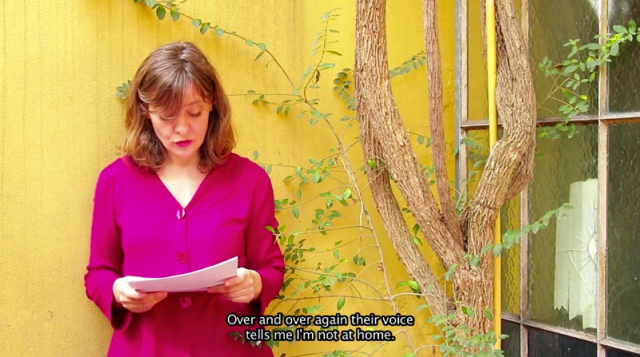
SK: Having worked with the theme of “the community” in some of my previous works, the director of the masters program in “Interdisciplinary Studies of Subjectivity” at the University of Buenos Aires wrote to me to put me in touch me with Dr. Noelia Billi, who was organizing a series of conferences on Maurice Blanchot at the National Library. Blanchot is known for working with the idea of the community, so this connection made sense.
After several meetings with Dr. Billi, I formulated the following question: What can I do beyond merely interpreting Blanchot and his literary theory? I immediately thought of a double hermeneutic:  I wanted to not only interpret Blanchot, but to interpret the interpretations of Blanchot created by his readers. Then, I started to think of a possible action I could take to accompany this idea: How can I build a bridge that connects Blanchot and his readers in Buenos Aires on one side, and the poets of Buenos Aires on the other side? This problem led to the creation of the film.
Blanchot1
Artifactoid: How did you decide upon the unique style and format of this film?
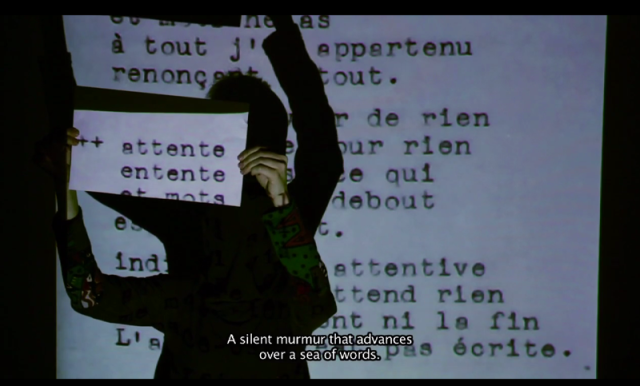
SK: I thought the best way to work with these questions would be a film, but not a conventional documentary. I was not interested in preexisting connections, but rather in making a film that could create its own connections. The majority of documentaries expose something existing, either past or present — something that preexisted the documentary. What I aimed to do with this film was create a documentary about something possible or imaginary, that doesn’t yet exist. In other words, the idea wasn’t to do research on the reception of Blanchot in Buenos Aires, but instead, imagine a poetic of Blanchot (a style of Blanchot-like thinking), imagine the possible connections between Blanchot, literary theory, and local poetry.
Blanchot3
Artifactoid: Once you had the original concept and format in mind, how did you bring the film to life?
SK: The next step was to figure out how to make this concept visible. I chose to represent it as two axes hinged together. The first axis was to work with a site-specific dimension (within the limits of Buenos Aires). The second axis consisted in transforming the concept into a narrative story.
For the first axis (the site-specific dimension) I decided to work with the geographic space and human resources I had at hand. For the first location, I chose the National Library, where the final video would eventually be projected, and where the intellectual capital of Buenos Aires and Argentina is stored.
Second, I chose the UBA’s Philosophy campus as a “resonant space” of Blanchot’s thought. Finally, I chose the artistic research center called, “Canal de Interferencias Artísticas,” as a space that crosses between “the poetic” and “thought,” — a space that ties together the library and university.
In addition, I decided to include Dr. Noelia Billi, who was finishing her doctoral thesis on materialism and language on Blanchot philosophy. Her research team also participated in the project, not only with the philosophical content of the project itself, but with technical operations, either as assistants, producers, cameramen or sound engineers.
Blanchot7
For the second axis (transforming the concept into a story), my idea was to articulate the concept in the following narrative sequence (synopsis):
Just before submitting her doctoral thesis on materialism and language, a Philosophy student comes across “The Blanchot Box” in the National Library: an unpublished project commissioned by Alberto Greco in a letter to the poet Ricardo Carreira. In the hands of the student, this unfinished work will [start to] take on a life of its own, tracing a/constructing a strange path/space out of the voices of philosophers and poets reflecting on the possible resonances of Maurice Blanchot’s thought in Argentine theory and poetry.
Blanchot4
Artifactoid: What is the reasoning behind the narrative structure of this film?
SK: For this film I was interested in using a poetic structure typical of Blanchot when telling the story: an open and undefined structure (as opposed to an Aristotelian poetic; a poetic of representation with a beginning, middle and end, typical of Hollywood movies).
The goal of the film is to demonstrate the ability to attach and detach the visible from its meaning, the words from their effects; attribution to reconfigure the distribution of certain provisions of the visible and thinkable. In this case, an imaginary system of a philosophical and poetic community that bring Blanchot to life through their words and sentences.
Blanchot5
Artifactoid: How did you select the different philosophers and poets that you chose to include in the film?
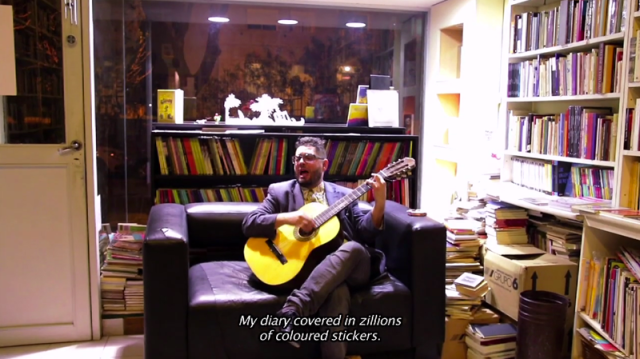
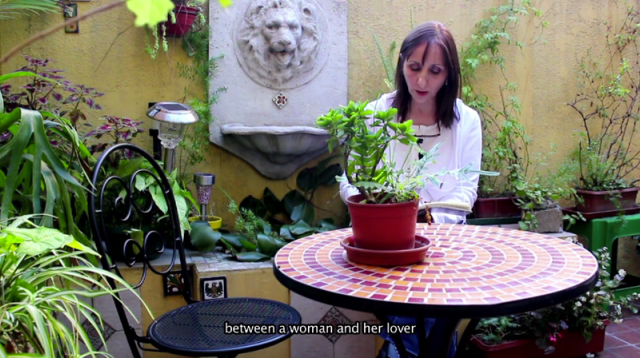
SK: The video references different poets that can be aggregated in two groups. The first one contains writers that Blanchot wrote about in his books: Borges, René Char, Beckett and Mallarmé. The second contains  the writers that I believe have possible connections with Blanchot’s topics and poetics. For example, Ricardo Carreira and his lyric materialism, where the writing is outside the will of the representational, and the words are how things work. These two ideas are also part of Leónidas Lamborghini‘s rewritings. Then, the others poets are connected with different topics that are part of the Blanchot Literary Theory: Vanna Andreini and “language,” Marina Mariasch and “the everyday life,” Francisco Garamona and Claudia Masín and “the aestethics of rocks.”
Blanchot2
Artifactoid: Why did you decide to work with the idea of the “Blanchot Box?”
SK: I worked with the idea of the Blanchot Box to give an image to the concept of the words and how things work. In other words, I transformed the image of the book into a box, and the idea of words into objects. If we think about artists who work with boxes, the first who comes to mind is Marcel Duchamp. And, a possible connection linking this idea to Buenos Aires is Alberto Greco: the first conceptual artist from Buenos Aires (and an artist who did different art-box projects). In addition, the role of Carreira in this film has to do with that he is a conceptual artist and writer who never had contact with Blanchot, but from my point of view, the literary theory and poetic of Blanchot resonates in Carreira’s poems: the writing is outside the will of representation, and words are how things work.
blanchot6
Artifactoid: How can this film be interpreted?
SK: On one hand, “Blanchot en Buenos Aires” can be interpreted as creative research, because for this film I didn’t research the literary thought of Blanchot nor his reception in Buenos Aires, but instead, I researched his possible and imaginary connections with his readers and the poets of Buenos Aires. In turn, the working methodology was flexible rather than circumscribed to conventional or tested methods of scientific and humanistic research.
On the other hand, one might think of this work within the framework of “non-creative writing.” I wove poems together with other analysis, without the need to ascribe signs to each participant indicating their names and professions. In a way, it was an appropriation.
Finally, both dimensions, creative and non-creative, were articulated by a fictional story that the viewer can investigate on his or her own. I am interested in the freedom of the viewer, or to quote a famous French philosopher: “the emancipated spectator.”
To conclude, Artifactoid is pleased to present the full film, “Blanchot en Buenos Aires:”